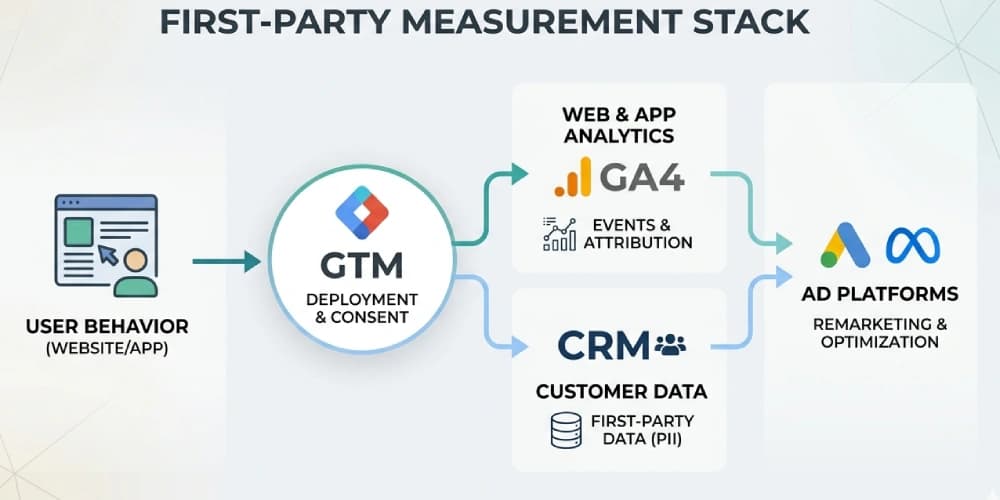
First-Party Measurement Stack: GA4, GTM, CRM, and Ad Platforms in 2026
The old model of digital measurement was simple:
- install analytics
- connect ads
- read reports
That model is not enough anymore.
In 2026, the businesses making the best marketing decisions are not relying on one platform. They are building a first-party measurement stack that connects website behavior, consent state, lead quality, and revenue outcomes into one system.
This is where modern Google Analytics consulting becomes much more than a tag-setup service.
What a First-Party Measurement Stack Means
It means your business is no longer depending entirely on third-party browser signals to understand performance.
Instead, you are building a system where:
- GA4 captures structured behavior
- GTM manages collection and deployment logic
- consent controls data usage responsibly
- CRM data defines quality and revenue outcomes
- ad platforms receive cleaner optimization signals
The goal is not to collect more data.
The goal is to create a more durable and more trustworthy version of the data you actually need.
Why This Shift Happened
Three forces pushed measurement in this direction:
1. Browser-level signal loss
Attribution is harder than it used to be. Identity and tracking persistence are more fragmented across browsers and devices.
2. Privacy requirements
Modern tracking has to respect consent, not work around it.
3. Automation inside ad platforms
Bid strategies increasingly depend on clean conversion signals. Weak measurement no longer just affects reporting. It directly affects media efficiency.
That is why the shape of your measurement stack now influences growth performance, not just analytics accuracy.
The Core Components
GA4
GA4 should be your structured event layer for web behavior and primary on-site conversion measurement.
Google Tag Manager
GTM should control how events are defined, triggered, and routed across your stack. It is not just a container. It is governance.
Consent Mode v2
Consent is part of the data flow now, not a separate legal overlay.
If this layer is weak, the rest of the stack becomes harder to trust. For a deeper view, read Consent Mode v2 for GA4 and Google Ads: What Actually Breaks Without It.
CRM
For lead generation, the CRM is where truth often gets sharper. A form fill is not the same as a qualified opportunity.
Ad Platforms
Google Ads and similar platforms should receive high-quality conversion signals, not just whatever happened first on the website.
What This Looks Like in Practice
For many businesses, a healthy measurement stack looks like this:
- User interacts with the site.
- GA4 and GTM capture the meaningful event.
- Consent state determines what can be processed and how.
- Key events are shared to ad platforms where appropriate.
- CRM outcomes are sent back as stronger quality signals.
- Reporting joins behavior and business outcomes into one decision layer.
That architecture is much stronger than relying on pageviews, imported conversions, and ad platform dashboards alone.
The Most Common Weak Point
The gap between website conversion and business outcome.
This is where many businesses lose visibility.
They know:
- who clicked
- who visited
- who submitted a form
But they do not know:
- who qualified
- who closed
- which source created actual revenue
That gap is why offline conversion tracking for Google Ads should be considered part of the stack, not a future add-on.
How Server-Side Tagging Fits In
Server-side tagging is often part of this architecture, but not always.
It becomes useful when you need:
- stronger first-party routing
- tighter control over data flows
- improved resilience against browser limitations
- better transformation and filtering of event payloads
If you are evaluating that layer, start with Server-Side Tagging for GA4: When It’s Worth It for Lead Gen and Ecommerce.
The Strategic Payoff
A first-party measurement stack creates better answers to questions like:
- Which campaigns drive qualified pipeline?
- Which landing pages influence revenue, not just leads?
- Which service lines attract the strongest intent?
- Which regions lose the most signal because of consent or browser behavior?
That means better:
- budget allocation
- bidding inputs
- forecasting
- funnel analysis
- executive reporting
Final Takeaway
The future of measurement is not one tool and not one dashboard.
It is a connected system where GA4, GTM, consent logic, CRM feedback, and ad-platform signals reinforce each other. Businesses that build this stack gain more than cleaner analytics. They gain a much more reliable foundation for growth decisions.