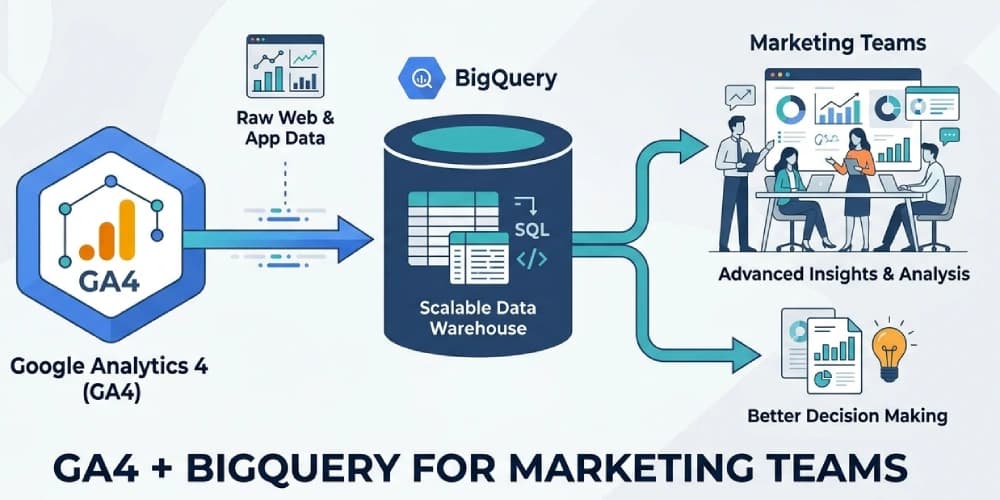
GA4 + BigQuery for Marketing Teams: When Native Reports Stop Being Enough
GA4 is powerful, but it has a ceiling.
For many teams, native reports are enough for a while.
Then the business starts asking harder questions:
- Which traffic source creates qualified revenue, not just leads?
- How do assisted journeys differ by service line?
- Which landing pages influence pipeline over time?
- Why do platform totals disagree with CRM outcomes?
That is the moment BigQuery stops being a nice-to-have and starts becoming part of the measurement stack.
If you are working with a Google Analytics consultant on an advanced setup, this is usually the stage where GA4 becomes the collection layer and BigQuery becomes the analysis layer.
The Short Answer
You should start thinking seriously about GA4 + BigQuery when:
- native reports cannot answer the questions the business actually has
- you need custom joins with CRM or backend data
- you want deeper attribution analysis
- event-level analysis matters more than dashboard convenience
You probably do not need it yet if:
- your team still struggles with basic event quality
- nobody is using current reports consistently
- your business decisions do not depend on advanced segmentation
What BigQuery Changes
BigQuery gives you event-level flexibility that GA4’s standard UI cannot always provide cleanly.
That means you can:
- join GA4 data with CRM outcomes
- build custom lead-quality models
- analyze long and messy conversion paths
- create channel or service-line reporting on your own rules
- audit edge cases more precisely
In other words, BigQuery is not replacing GA4.
It is extending it.
Why Marketing Teams Reach This Point
Most teams do not hit BigQuery because they want more complexity.
They hit it because native reporting stops being enough for practical reasons:
1. The business operates across multiple systems
GA4 knows about web behavior. The CRM knows about lead quality. The ad platform knows about cost and campaign logic.
If those systems are never joined, reporting stays partial.
2. Standard reports flatten nuance
As soon as you need to understand service mix, customer stages, or assisted paths, off-the-shelf reports start feeling restrictive.
3. Leadership wants answers, not dashboards
Marketing teams are often asked questions that require business logic rather than default reporting views.
That is where event-level analysis becomes valuable.
A Practical Use Case
Imagine a lead generation business with three service lines:
- analytics consulting
- Google Ads consulting
- development services
GA4 can show form fills by channel.
But leadership wants to know:
- which channel creates qualified leads for each service line
- which landing pages influence closed revenue
- which campaigns generate sales-ready pipeline fastest
That usually requires joining:
- GA4 events
- CRM stage data
- campaign metadata
This is exactly why BigQuery becomes relevant.
What BigQuery Does Not Fix
It does not fix:
- weak event naming
- duplicate firing
- missing consent logic
- bad data-layer design
- missing offline conversion strategy
If your collection layer is unreliable, BigQuery just gives you a more advanced place to inspect unreliable data.
That is why businesses should clean up measurement design first with a strong GA4 measurement plan.
Signs You Are Ready
You are ready for GA4 + BigQuery if:
- your event setup is stable
- your team already uses GA4 seriously
- CRM connection matters
- reporting questions are becoming more advanced
- you need more trust in attribution and funnel analysis
You are not ready if your team still argues about whether the main conversion event is even correct.
Where This Fits in the SEO and Growth Stack
For service businesses, stronger analytics does not just help paid media. It also improves how you evaluate:
- SEO landing page performance
- content-assisted conversions
- service-page intent quality
- branded vs non-branded traffic outcomes
That is why deeper analytics work often becomes part of a broader growth system rather than an isolated reporting project.
Final Takeaway
GA4 is the operating dashboard. BigQuery is the flexible analysis engine behind it.
When the questions your business needs answered are more advanced than the native interface can support cleanly, moving into BigQuery becomes a strategic step. The key is to do it after the measurement foundation is clean, not before.