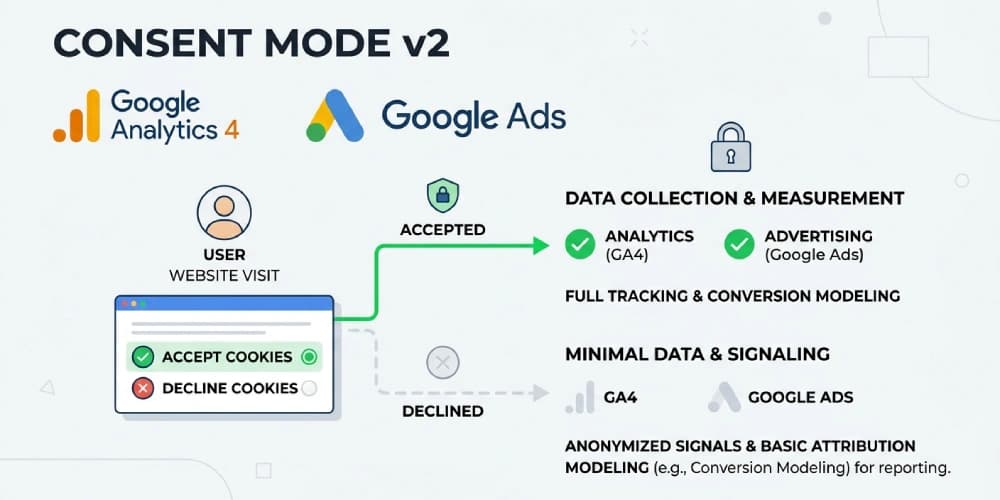
Consent Mode v2 for GA4 and Google Ads: What Actually Breaks Without It
Consent Mode v2 is often explained like a compliance feature.
That is technically true.
But from an analytics and paid-media perspective, it is more useful to think of it as a measurement control layer.
When it is missing or configured incorrectly, you do not just create privacy risk. You break the way GA4 and Google Ads understand user behavior, conversions, and modeled performance.
That is why this topic now shows up in serious Google Analytics consulting work instead of living only in legal or CMP checklists.
The Short Answer
Without a proper Consent Mode v2 setup:
- GA4 loses visibility on part of your traffic
- Google Ads receives weaker conversion signals
- modeled reporting becomes less reliable
- remarketing and audience logic can break
- leadership starts comparing mismatched numbers across tools
The result is not just missing data.
It is worse decision-making.
Why This Matters More in 2026
The old mindset was:
"We have a cookie banner, so we are covered."
That is no longer enough.
Modern measurement depends on how consent signals are communicated before tags fire, after consent changes, and across connected systems. If your CMP, GTM container, GA4 property, and Ads setup are not aligned, you end up with a stack that is technically live but strategically unreliable.
What Actually Breaks Without It
1. Conversion reporting gets weaker
When analytics and ads storage permissions are not passed correctly, a meaningful share of sessions and conversions become partially observable or invisible. This is especially damaging for:
- paid search
- ecommerce flows
- lead generation landing pages
- traffic from privacy-heavy browsers and regions
2. Smart bidding loses signal quality
Google Ads optimizes toward the conversion data it receives.
If consent implementation suppresses too much data, misfires tags, or sends inconsistent signals, bid strategies can overvalue weak traffic and undervalue profitable segments.
That is why consent strategy should be considered part of acquisition performance, not just governance.
3. GA4 and Google Ads numbers drift further apart
If your team is already dealing with mismatched reporting, incomplete consent handling will make it worse. GA4, Ads, and CRM systems begin operating from different slices of reality.
If that is already happening, read Why GA4 and Google Ads Conversion Numbers Don’t Match.
4. Audience building gets less dependable
Audience logic built from incomplete or delayed consent-aware tracking is weaker. That affects:
- remarketing pools
- engagement-based audiences
- high-intent retargeting groups
- suppression logic for existing leads or customers
5. Reporting trust drops
This is usually the hidden cost.
Marketing teams stop trusting platform numbers. Leadership stops trusting marketing reports. And every planning conversation gets slower because nobody is fully confident in the inputs.
The Most Common Implementation Mistakes
Here is what I see most often:
Cookie banner installed, but no real consent orchestration
The banner exists, but GTM is still firing tags before consent state is properly set.
Consent updates happen too late
The page loads, tags fire, and only afterward does the platform receive the final consent state.
GA4 and Google Ads are treated separately
They are configured in isolation instead of as one measurement system.
No QA across accepted and rejected states
Many teams only test the happy path where users accept everything.
That does not validate the real implementation.
How Consent Mode v2 Fits Into a Modern Stack
The strongest approach is usually:
- a consent management platform to collect preferences
- a web GTM container that respects those states before tag execution
- GA4 and Google Ads configured to receive the right consent signals
- server-side tagging where it makes architectural sense
- CRM or offline conversion integration where lead quality matters
That is why Consent Mode v2 often sits next to server-side tagging for GA4 rather than outside it.
A Better KPI for This Project
Do not judge your consent implementation by whether a banner appears.
Judge it by whether your business can still answer the questions that matter:
- Which channels are driving qualified leads?
- Which campaigns are producing revenue, not just form fills?
- Which audiences should receive more budget?
- Which regions or devices show the largest signal loss?
If your team cannot answer those questions after launching a CMP, you completed a UI project, not a measurement project.
When to Prioritize This Immediately
Move this higher on your roadmap if:
- you run Google Ads at a meaningful spend level
- you serve traffic in regulated markets
- reporting got noisier after a CMP rollout
- your remarketing pools shrank unexpectedly
- GA4 and Ads numbers became less stable over time
At that point, the issue is no longer theoretical. It is performance-related.
Final Takeaway
Consent Mode v2 is not a side quest for compliance teams.
It is part of the infrastructure that keeps modern measurement usable.
If GA4 and Google Ads are central to your growth engine, you need consent logic that protects privacy and preserves decision-quality data. That is exactly where a GA4 consultant adds leverage: by designing consent, tracking, and ad-platform signals as one coherent system instead of a collection of separate fixes.