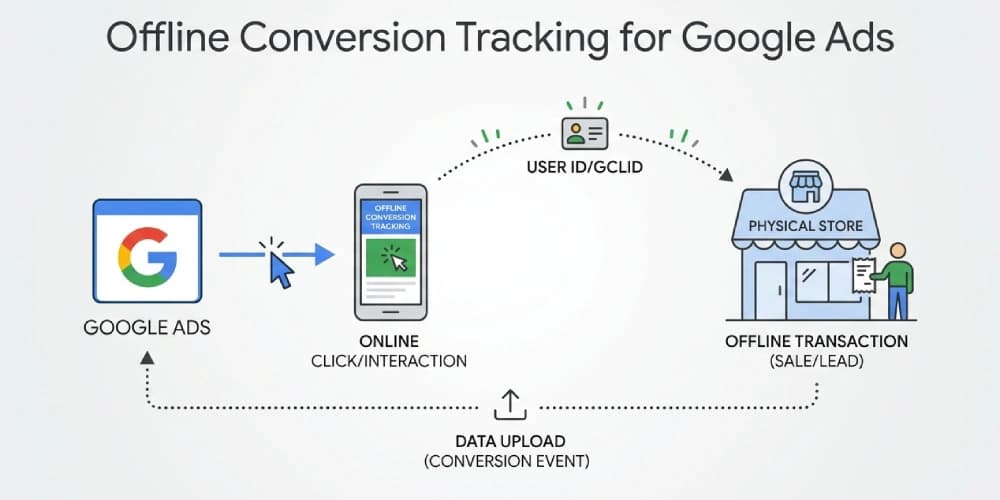
Offline Conversion Tracking for Google Ads: The Missing Piece in Lead Quality
For lead generation businesses, one of the most expensive measurement mistakes is also one of the most common:
Google Ads is optimizing toward lead volume, while the business actually cares about lead quality.
That gap is where offline conversion tracking becomes critical.
If you are investing in paid media and your sales team qualifies leads after the initial form submission, your ad account is almost certainly missing the signal that matters most.
This is exactly where strong Google Ads consulting and Google Analytics consulting should overlap.
What Offline Conversion Tracking Actually Does
Offline conversion tracking sends downstream outcomes from your CRM or sales process back into Google Ads.
Instead of telling Google only:
- someone filled out a form
you can also tell it:
- this lead became sales qualified
- this opportunity reached a meaningful stage
- this deal closed
- this customer generated real revenue
That changes how the platform learns.
Why This Matters So Much in 2026
Modern ad accounts rely heavily on automated bidding.
That is a good thing when the platform is trained on strong signals.
It is a dangerous thing when the platform is trained on weak ones.
If your current primary conversion is just generate_lead, Google Ads may aggressively pursue:
- low-intent submissions
- spammy leads
- students or job seekers
- markets outside your ICP
because the system cannot tell the difference.
Offline conversion tracking gives it a better target.
The Typical Lead Gen Problem
The reporting flow often looks like this:
- User clicks ad.
- User submits form.
- Google Ads counts a conversion.
- Sales team reviews the lead later.
- Half the leads are poor-fit.
- The ad platform never learns that difference.
That is how businesses end up scaling the wrong campaigns.
What Should Be Sent Back to Google Ads?
That depends on your sales cycle, but common examples include:
- marketing-qualified lead
- sales-qualified lead
- booked meeting
- proposal sent
- closed won
- revenue value
You do not need to send every CRM stage.
You need to send the ones that meaningfully improve bidding decisions.
Where GA4 Fits In
GA4 is still useful here, especially for:
- website behavior analysis
- funnel exploration
- event validation
- source and landing-page insight
But for lead quality, GA4 alone is not enough.
If the meaningful business outcome happens outside the website, then a website-only tracking tool cannot be your final source of truth.
That is why a GA4 measurement plan for lead generation websites should explicitly map which stages stay in GA4 and which stages must come from the CRM.
The Most Common Mistakes
1. Importing everything
More imported stages do not always create better bidding.
Too many noisy signals can dilute the event that actually matters.
2. Waiting too long to set it up
Teams often delay offline conversion tracking until after campaign scale. That means months of machine learning trained on incomplete outcomes.
3. No value framework
If all leads are sent back with the same value, Google still cannot distinguish between high-margin and low-margin opportunities.
4. Broken matching logic
If click IDs, identifiers, or record matching are inconsistent, imports become unreliable fast.
When It Delivers the Biggest Lift
This setup is highest leverage when:
- your average deal value is meaningful
- sales qualification happens after the initial lead
- your close cycle is not instant
- campaigns serve multiple service lines or markets
- budget decisions depend on quality, not just volume
For simple direct-response offers, you may not need a complex CRM feedback loop.
For most lead gen businesses spending aggressively, you almost certainly do.
How It Changes Optimization
Once quality signals flow back, you can start making better decisions about:
- which campaigns deserve more budget
- which keywords generate pipeline instead of noise
- which landing pages attract qualified leads
- which geographies or devices convert into revenue
That is when paid search stops being a traffic channel and starts becoming a revenue system.
If your account still suffers from reporting disagreement across platforms, read Why GA4 and Google Ads Conversion Numbers Don’t Match next.
Final Takeaway
If Google Ads only sees the first conversion step, it will optimize for the first conversion step.
That is the whole problem.
Offline conversion tracking closes the loop between ad spend and real business outcomes. For lead gen companies, that often becomes the single highest-value measurement improvement because it helps the platform learn what a good lead actually looks like.