Many businesses assume Google Ads is expensive because Google simply charges too much.
That is not usually the full story.
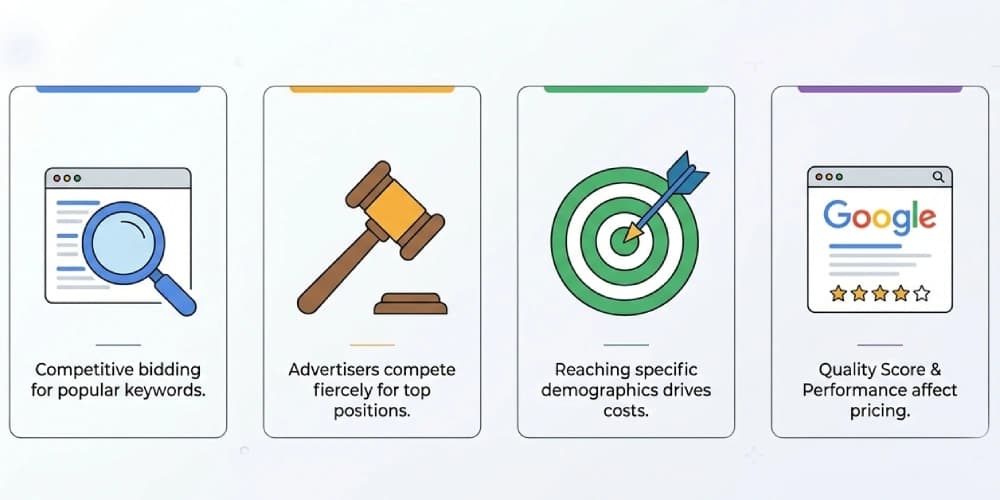
Google Ads becomes expensive when high auction pressure meets weak account structure, weak conversion data, or weak business economics. In other words, the platform is often exposing inefficiency that was already there.
The Short Answer
Google Ads gets expensive because of some mix of:
- intense keyword competition
- low Quality Score
- broad or inefficient targeting
- weak landing-page relevance
- poor conversion tracking
- bidding toward low-quality leads
- margins that do not support the auction
High CPCs are a symptom.
The deeper question is whether your account is expensive because of the market, or because the system is teaching Google to buy the wrong traffic.
1. Competitive auctions drive up CPCs
This is the most visible reason.
If multiple advertisers want the same commercial-intent keyword, cost-per-click rises. That is normal, especially in:
- legal
- home services
- B2B software
- healthcare
- finance
- high-ticket local services
But expensive keywords are not automatically bad keywords. They can still be profitable if the back-end economics are strong.
2. Low Quality Score makes every click harder to win
When ad relevance, expected CTR, or landing-page experience are weak, Google usually requires more money to stay competitive.
That means two advertisers can target the same query, but the weaker account pays more for worse traffic.
This is one reason Google Ads consulting is often less about "spending more" and more about improving structure, relevance, and conversion architecture.
3. Broad targeting brings expensive noise
Accounts often get expensive because they are paying for traffic that was never a good fit.
Common sources of waste:
- broad match without strong exclusions
- weak negative keyword management
- mixed-intent keywords in the same campaign
- geographies that do not convert well
- mobile traffic with poor lead quality
This creates the feeling that Google Ads is expensive when the real problem is low-precision traffic acquisition.
4. The landing page is too generic
If the ad promises one thing and the page delivers another, conversion rate drops.
That makes every click more expensive because you need more clicks to generate the same number of opportunities.
A weak landing page increases effective cost even if CPC stays unchanged.
5. Smart Bidding is learning from weak signals
Automation is powerful, but only if the input data is strong.
If Google Ads is optimizing toward:
- basic form fills
- low-intent conversions
- duplicate events
- imported actions that do not reflect revenue
then the platform may scale the cheapest conversions rather than the best outcomes.
This is exactly why offline conversion tracking for Google Ads matters so much in lead generation.
6. Your measurement stack is under-reporting or misreporting value
If GA4, Google Ads, and your CRM do not align, you may be making budget decisions from incomplete signals.
That usually leads to one of two bad outcomes:
- good campaigns look weaker than they are, so budget gets reduced too early
- weak campaigns look acceptable, so waste continues longer than it should
If reporting already feels inconsistent, read Why GA4 and Google Ads Conversion Numbers Don't Match.
7. The account is structured around leads, not economics
This is where many service businesses get stuck.
They ask:
- how do we get cheaper leads?
when the better question is:
- how do we get more profitable customers?
If one campaign produces fewer leads but much higher close rates, it may be cheaper in business terms even if the CPL looks worse inside the platform.
8. The offer is weak relative to the market
Google Ads does not fix weak positioning.
If competitors have stronger:
- pricing
- guarantees
- brand trust
- sales process
- landing-page clarity
then auction costs feel painful because the business is converting at a disadvantage.
9. Budget scale is revealing problems that were hidden at lower spend
At low spend, inefficiencies can stay hidden.
Once budget increases:
- poor segmentation becomes more obvious
- low-quality search terms get more exposure
- bad conversion signals train bidding faster
- weak geographies consume more spend
The account then feels like it suddenly became expensive, when the real issue is that scale exposed structural weakness.
What to Fix Before You Raise Budget
Before increasing spend, fix these first:
- Separate branded, non-branded, and service-line intent where appropriate.
- Tighten negative keywords and search-term review.
- Improve landing-page relevance and message match.
- Audit conversion actions and remove weak signals.
- Add revenue or quality feedback through CRM and offline imports.
- Re-evaluate bids against margin, close rate, and lifetime value.
If your setup is still using a shallow event model, start with a GA4 measurement plan for lead generation websites.
When Expensive Is Actually Fine
Some clicks should be expensive.
If a keyword has:
- strong purchase intent
- high close rates
- large deal value
- repeat revenue potential
then a high CPC can still produce excellent economics.
The goal is not cheap traffic.
The goal is profitable customer acquisition.
Final Takeaway
Google Ads is rarely expensive for only one reason.
It gets expensive when competition meets weak relevance, weak data, or weak economics.
If you only try to lower CPC, you may miss the bigger opportunity. The more valuable move is often improving measurement, segmentation, and offer-to-intent fit so the same auction becomes more profitable.