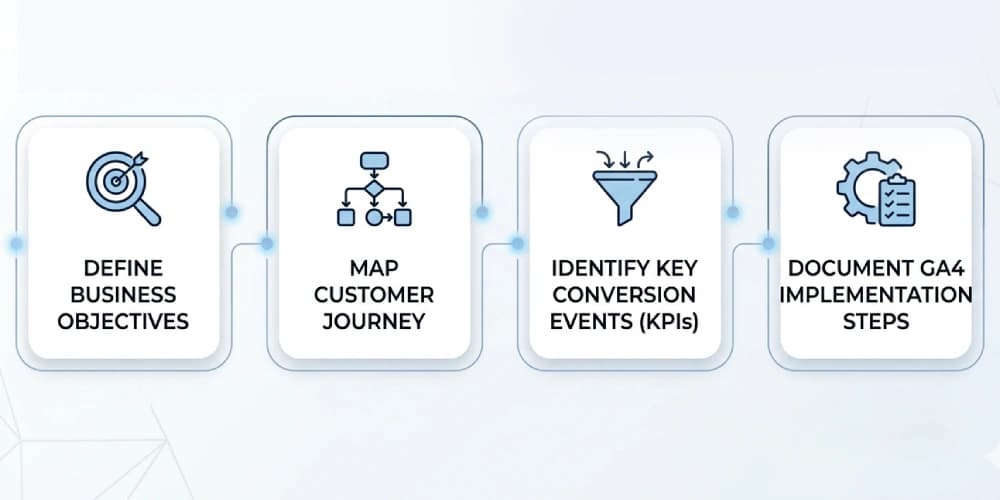
How to Build a GA4 Measurement Plan for Lead Generation Websites
Most lead generation tracking setups are too shallow.
They capture:
- pageviews
- button clicks
- maybe a form submit
And then teams wonder why reporting feels noisy, Google Ads bidding feels unstable, and leadership still cannot answer basic funnel questions.
The missing piece is usually not another tag.
It is a measurement plan.
This is one of the highest-leverage deliverables in any serious Google Analytics consulting engagement because it defines what the business should measure before anybody touches GTM, GA4, or reporting.
What a Measurement Plan Actually Is
A GA4 measurement plan is a structured document that maps:
- business goals
- user journey stages
- the events that represent those stages
- parameters needed for context
- the destination of that data across GA4, Google Ads, and CRM systems
Without this layer, most implementations become a loose pile of events with no reliable business meaning.
Why Lead Gen Sites Need This More Than Ecommerce
Ecommerce has a built-in anchor: the purchase.
Lead generation businesses usually do not.
Instead, value is spread across stages like:
- first inquiry
- booked call
- qualified opportunity
- closed deal
If you only track the first form fill, your ad platforms optimize for volume, not quality. That is why measurement planning must include downstream stages even if some of them live in the CRM rather than GA4.
The 5 Questions to Answer First
Before defining events, answer these:
- What does a high-quality lead look like?
- Which user actions are true buying signals?
- Which actions are just engagement noise?
- What does Google Ads need to optimize toward?
- Which stages must be validated in the CRM?
If those answers are fuzzy, event naming will not save you.
A Simple Measurement Framework
Here is a practical way to structure it.
1. Map the funnel stages
For most lead gen sites:
- awareness
- engagement
- inquiry
- qualification
- revenue
2. Assign one primary event to each critical stage
Example:
| Funnel Stage | Example Event | Notes |
|---|---|---|
| Engagement | view_service |
High-intent page view, not every pageview |
| Inquiry | generate_lead |
Main form or booking request |
| Qualification | qualified_lead |
CRM-confirmed stage, often offline/imported |
| Revenue | closed_won |
Final business outcome |
This alone is enough to improve decision quality because it separates curiosity from commercial intent.
3. Define the parameters that matter
Most lead gen teams stop at event names.
That is not enough.
You also need context such as:
- service type
- landing page group
- lead source
- region
- device category
- estimated deal value
This is what turns reporting from generic activity tracking into usable business analysis.
What to Avoid
These are the common mistakes:
Tracking every click as if it matters
Not every interaction deserves executive attention or bidding influence.
Using inconsistent event naming
If one team calls it form_submit and another uses lead_form_complete, the reporting layer gets messy fast.
Treating micro-conversions as primary outcomes
A brochure download and a booked sales call are not equal signals.
Forgetting the CRM handoff
If lead quality is determined after the website conversion, your measurement plan must extend beyond GA4.
This is where offline conversion tracking for Google Ads becomes essential.
How This Connects to Google Ads
A measurement plan is not just for analytics cleanliness.
It directly improves paid-media performance because it tells you:
- which events should become key events in GA4
- which conversions should be primary in Google Ads
- which signals are too weak for bidding
- which values should be passed for better budget allocation
If your account is optimizing toward low-intent form fills, the issue is often upstream in the measurement plan rather than downstream in campaign settings.
This is one reason analytics and paid-media work need to stay aligned with your Google Ads consulting strategy.
A Practical Lead Gen Event Set
You do not need a giant taxonomy to start.
For most businesses, a clean v1 looks like:
view_serviceclick_contactstart_formgenerate_leadbook_consultationqualified_leadclosed_won
The trick is not adding more events.
The trick is making sure each event has a clear owner, definition, and business use.
When to Rebuild Your Plan
You should revisit the plan when:
- you launch new services
- your sales process changes
- campaign strategy shifts to new markets
- GA4 and CRM totals stop telling the same story
- reporting is full of events nobody uses
If your tracking grew organically without documentation, it is usually cheaper to rebuild the system now than keep working around it later.
Final Takeaway
A good GA4 setup starts with business logic, not tags.
For lead generation websites, the strongest measurement plan is the one that connects on-site intent, downstream lead quality, and revenue outcomes into one system. That gives GA4 cleaner reporting, gives Google Ads better bidding signals, and gives leadership a much more trustworthy view of growth.