Why Google Ads Accounts Get Suspended: Common Causes and Recovery Steps
Few Google Ads problems are more disruptive than logging in and seeing that the account has been suspended.
At that point, the issue is no longer campaign optimization.
It becomes an account-trust and recovery problem.
The Short Answer
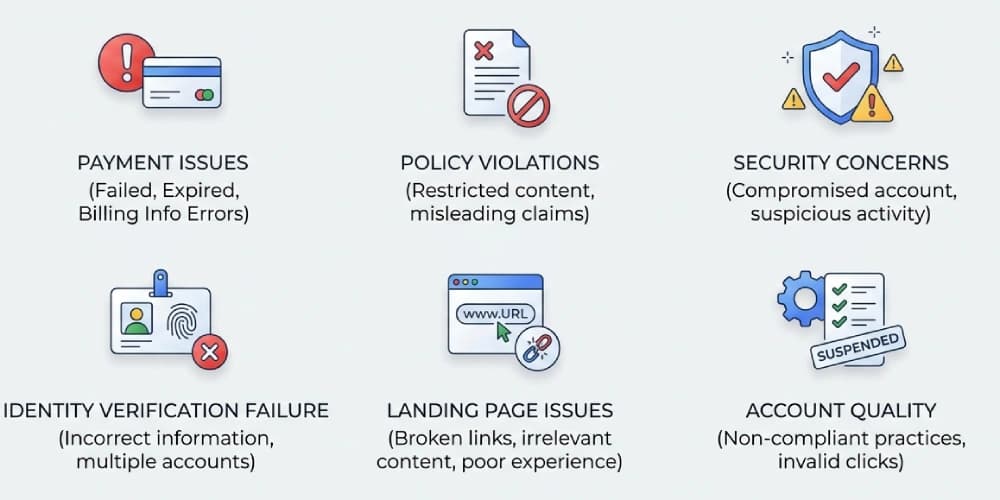
Google Ads accounts usually get suspended because of:
- policy violations
- billing or payment problems
- suspicious or inconsistent account behavior
- business verification issues
- destination or website trust issues
- repeated disapprovals that point to a larger compliance problem
The most important mistake is treating suspension like a minor ad disapproval. It is not.
What "Suspended" Actually Means
A suspended account usually means Google has restricted the account from serving ads until the issue is resolved or reviewed.
That is different from:
- a disapproved ad
- a limited campaign
- a manually paused account
If your campaigns stopped spending and you are not sure whether the issue is suspension or normal delivery failure, read Why Google Ads Is Not Working: 11 Reasons Campaigns Are Not Running or Converting.
The Most Common Reasons Google Ads Accounts Get Suspended
1. Billing and payment issues
Billing failures can trigger serious account restrictions, especially when there are repeated charge failures, suspicious payment behavior, or mismatched account details.
Examples include:
- declined cards
- repeated payment retries
- inconsistent billing information
- use of unsupported or risky payment methods
2. Circumventing systems or misrepresentation concerns
This is one of the most serious policy areas.
Google may suspend accounts it believes are:
- hiding important business details
- making misleading claims
- redirecting users deceptively
- operating websites that do not clearly establish trust
Even if the business feels legitimate internally, the external signals may still look risky to Google.
3. Website or destination problems
Your website is part of account trust.
Suspension risk rises when the destination has issues like:
- broken pages
- incomplete legal pages
- unclear offers
- poor contact details
- thin content
- aggressive popups or misleading UX
Google does not only review ads. It reviews what users experience after the click.
4. Business operation verification problems
Some accounts run into trouble because verification requests are ignored, delayed, or submitted with inconsistent information.
When Google cannot confidently verify who is behind the ads, trust drops fast.
5. Repeated policy disapprovals
A single disapproved ad does not always mean suspension.
But repeated disapprovals across the same themes can signal a broader compliance issue. Over time, that can escalate from creative-level problems to account-level enforcement.
6. Compromised or suspicious account activity
If login behavior, payment behavior, or account changes look unusual, Google may intervene to protect users and the platform.
This can happen even when the advertiser did not intend to violate policy.
Suspended vs Cancelled: They Are Not the Same Thing
This is where many searches get mixed together.
Suspended account
- usually tied to trust, policy, or enforcement
- ads stop serving because Google restricted the account
- recovery usually requires fixing the root cause and going through review or appeal
Cancelled account
- often means the account was closed by an admin or became inactive
- it is not necessarily a policy punishment
- reactivation is usually more straightforward than a suspension case
So if you are searching "why is my Google Ads account cancelled," the answer may be very different from a suspension case. Cancellation is often administrative. Suspension is usually enforcement-related.
What To Do After a Suspension
1. Read the notice carefully
Do not guess the cause from memory.
Review the exact policy or reason shown in the account. Suspension handling gets worse when teams fix random things instead of the issue Google actually identified.
2. Audit the website, billing, and account details together
Do not only check ads.
Review:
- payment setup
- billing profile details
- contact information
- legal pages
- offer clarity
- business identity consistency
- redirect behavior
3. Fix the root cause before appealing
An appeal without real changes usually wastes time.
If the problem involves trust, your site and account need to look materially more credible and consistent before you ask for review.
4. Document what changed
When possible, be specific:
- what issue was identified
- what pages or settings were updated
- what business details were clarified
- what compliance steps were completed
Specificity is more useful than emotional language.
5. Avoid creating replacement accounts impulsively
Trying to work around enforcement by opening new accounts can make the situation worse.
If the root issue is unresolved, the problem often follows the new setup.
When Suspension Is Really a Larger Business Problem
In many cases, suspension is not just a policy problem.
It is a signal that the business has weak external trust markers:
- unclear positioning
- weak website credibility
- inconsistent business information
- aggressive claims
- no real measurement or operational structure behind the ads
That is why recovery often overlaps with broader Google Ads consulting, site cleanup, and conversion architecture improvements rather than a single policy appeal.
Final Takeaway
Google Ads account suspension usually points to a trust, policy, billing, or verification issue, not a normal campaign problem.
The best response is not panic and not guesswork.
It is a structured review of the actual notice, the website, the billing setup, and the business signals behind the account. Once the root issue is fixed, the recovery path becomes much clearer.